Art McKay
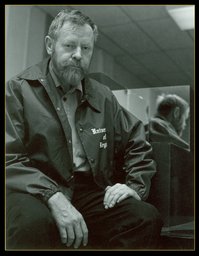
Art McKay
Arthur Fortescue McKay, generally referred to as Art McKay, was born in Nipawin, Saskatchewan in 1926. A member of the Regina Five, McKay gained international recognition when his work was included in the Post Painterly Abstraction show in Los Angeles in 1964. Following high school McKay joined the army, but by the time his training was over, so was the war. The army had given him aptitude tests upon discharge, which showed his ability to be in writing, visual art and music. McKay chose art and went off to the Provincial Institute of Technology and Art in Calgary (1946-1948). After art school McKay, and wife Lori, left for Europe where they worked in England and later studied in Paris at the Academie de la Grand Chaudiére. He also studied at Columbia University and the Barnes Foundation in Merion, Pennsylvania in 1956 and 1957, traveling back and forth between New York and Merion for classes. Returning to Regina in 1951 McKay enrolled in art history class at the School of Art, University of Saskatchewan, Regina Campus. The following year he was hired by Ken Lochhead as a Special Lecturer in Art with the School of Fine Arts at Regina. He became Associate Professor of Art in 1956 and served as the Director of the School of Art from 1964 to 1967.
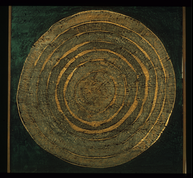
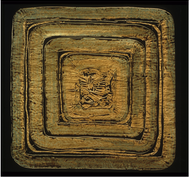
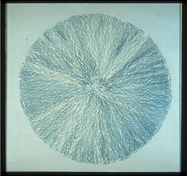
McKay is most noted for his scraped enamel mandalas, which utilize circular and rectangular formats to create highly contemplative images reflecting his interest in Zen Buddihism. Among the various influences on his development, McKay stated that it was fellow Regina Five artist Ron Bloore's use of the mandala that was crucial to his own work. In the 1970's he continued to paint abstract but also reintroduced the landscape in his work. McKay taught at the University of Regina as an Associate Professor until his retirement in 1987. He moved to Vancouver in 1994 to be close to family. Art McKay passed away August 3rd, 2000 at the age 73.
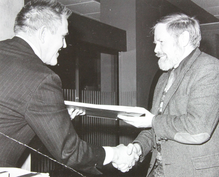
2000-44 #2
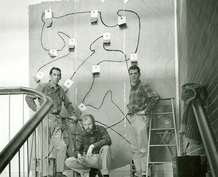
86‑29 Box 15 File 151 Photo 42
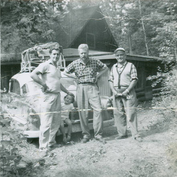
87‑43 Box 7 Photo 12
While in Regina McKay, alongside Lochhead, was responsible for founding the Emma Lake Artist Workshops in 1955. This innovative summer workshop initiative greatly contributed to the development of contemporary art in Saskatchewan and Canada. McKay served as co-ordinator of the 1957 Emma Lake Workshop, led by the American artist Will Barnett. In 1959, McKay and fellow painting teacher Roy Kiyooka, chose American abstract impressionist Barnett Newman as workshop leader. It was American critic Clement Greenberg, who led the 1962 Emma Lake Workshop that would play a major role in McKay's development. Greenberg greatly admired McKay's work and ranked it with other esteemed Canadian abstract painters including him in the 1964 Los Angeles County Museum exhibition called Post Painterly Abstraction.
 Last reviewed: 2011-Dec-15